Friday, March 13, 2015

Islands of Complexity

By Conor King Devitt


What can I really do here?
A weird question, I know, especially given the lucky circumstances. After all, I’ve been gifted a free trip – no expense unpaid, no hidden fees, no additional strings attached. Just the one requirement – I will report and write, tell a story and describe the issues, using all of the values and skills I built and learned here.
The Murrow College selected me as one of the 2015 Backpack Journalism Scholars, both an honor and an opportunity. I am one of a few fortunate students who gets to soar across the world and test my skills in a location starkly different from the rolling hills, crackerjack cafes and red brick academic castles of Pullman, Washington. 
My assigned destination is a historical, literary and biological favorite: Darwin’s Galapagos Islands, the geographic home court for the modern theory of evolution. Thanks to the college and all its benefactors, I will get to see species of plants and animals only associated with this isolated archipelago. Thanks to the college, I will get to meet some of the hardy people working on the front lines to preserve these rare pieces of global history. Thanks to the college, I will get to embark on one more globetrotting adventure before I graduate.    
I’m excited for the challenge, the travel, the opportunity to prove myself. But as I complete pre-trip research, my mind has become increasingly haunted by this thought:
What can I really do? What can I really say?
The Galapagos conservation effort involves intricate global cooperation between governments and interest groups, science and money, lab examination and fieldwork. Hundreds of diverse, hardworking and nameless souls shoulder the weight of protecting the incalculable importance of the islands, contributing their time in science, money, advocacy, government and other fields I can’t even claim to know.  
These are the people whose jobs aren’t explained, whose missions are too specified to be articulated to the unknowing and uninvolved. Sure, the larger personalities associated with conserving the islands can come together and paint the different efforts in layman’s terms. They did just that for the book Galapagos: Preserving Darwin’s Legacy, a helpful guide in my own personal research.
But even a project like that, written by the experts, is forced to reduce the intimidating number of complexities associated with the islands to superficial terms an outsider like me can understand. Its authors are people who have spent decades on the ground and in offices around the world spearheading these different efforts and relationships, and even they struggle to describe all that goes into protecting the Galapagos.
So again, it begs the question: How can I, as a journalism student whose biggest scientific achievement is an A- in freshman biology, report on something so meaningful? I have one week in the islands, and I don’t wish to squander the opportunity simply enjoying it as a sunburnt tourist. However, I also don’t want to clock in a routine, glazed-over piece of reportage that is content to simply tell two sides and the five W’s, disseminating already-condensed lay knowledge into even simpler terms.  Given my limited time and even more limited knowledge, what can I actually do to service the truth? How can I contribute?
I lobbed the question to Dr. Christine Parent, an evolutionary ecologist and an assistant professor at the University of Idaho. Parent has spent more than two years in the field studying endemic land snails on the Galapagos Islands, where there are more than 80 different species and subspecies.
Parent was bursting with knowledge – on history, organizations, projects, and current research. She didn’t have just a single answer to my inquiry (who would?) and instead chose to paint me a better picture of the islands as a whole, describing the hook to several interesting storylines I could explore.
Some I had researched already – like the nasty conflicts between local fishermen and conservation groups on several of the more populated islands, including San Cristobal, my destination for the week. The locals want to work, fish and support themselves. Conservationists want fishermen to stop harvesting resources from the islands’ one-of-a-kind marine ecosystem. And even though I knew a bit about the issue, Parent managed to layer my basic ideas with the kind of grounded knowledge one only accumulates by actually putting their boots on the island’s volcanic dirt.
Others storylines she introduced were completely new to me, like the recent financial issues plaguing the Charles Darwin Foundation’s research station on the island of Santa Cruz. A brief surf through the shallow waves of the web reveals little media coverage on the incident, despite the fact that it has been the archipelago’s primary research center since 1964. While the foundation’s press releases report that a recent upswing in donations have helped the station recover, I have a feeling there’s more story to harvest.
After talking to Parent about the flux of issues flowing through the islands and the different opportunities to investigate them, I started to feel a bit better. I’m no expert and never will be, but that shouldn’t stop me from attempting to widen the sphere of public knowledge about the islands. I’m hopeful that once I’m down there I’ll be able to focus my gaze, discover a niche and put any skills I might have to good use. And if I manage to talk to the right people, read the right research and ask the right questions, I believe there’s a chance I could bring something of value back for readers.  
My paranoia would probably have seemed foolish to a veteran journalist. A seasoned professional could parachute in and rip a story out of the landscape, doing his/her job and scoring quality material in the process. Getting to worry and fret about journalism’s role and purpose in a place like the Galapagos is a luxury likely afforded by my own youthful idealism. However, I get to worry about it. That’s part of the prize. This is my trip, my project, my attempt at writing something real. And I intend to do just that.


The Outcomes of Isolation

By Conor King Devitt


It’s going to be a marathon. Our expedition to the Galapagos begins on Friday evening with a 1.5 hour cruise north to Spokane. At 7 the next morning, we’ll fly three hours to Minneapolis, where we’ll change planes and soar 2.5 hours south to Atlanta. From here, we’ll hop on a 757 and jet 5.5 hours down to Quito, Ecuador. After spending a night in Quito, we’ll fly an hour to Guayaquil, Ecuador, where I assume we’ll be swept of invasive species and fumigated before our last leg. From Guayaquil it is a two hour hop to the island of San Cristobal, our toilsome final destination.
I’ve experienced grueling, cross-hemisphere travel before, and I’m thankful this time I’ll be going with a partner – one of the college’s skilled senior videographers, Marc Wai. The last time I didn’t have that luxury. The last time, I went alone.   
Weirdly, this will be the second occasion in two years I’ve embarked on a lightning-paced trek into the South Pacific. My first trip was a whimsical journey of self-discovery, an adventure that led me to another one of the globe’s most iconic and storied islands.
It was the summer after sophomore year, and I was working 85-hour weeks as deckhand on a small cruise ship that paddle-wheeled its way up and down the Mississippi and Ohio Rivers. I was making good money – more than I had expected, and realized I would have some splurge-worthy income sitting in my bank account by the end of the season.
I started looking into different travel opportunities. I wanted a prize – something that would keep my eyes focused and forward. Twelve hour days of manual labor under the violent, southern sun often made it hard to not think about quitting, and a non-refundable treasure at the end of the hunt insured I wouldn’t act on those impulses.
I also needed a purifier. Like others working in fishing industries, coal mines, aggressive car dealerships or anywhere were the balance between work and life is skewed, our social existence was a rollicking, unhealthy one, burdened by riverfront booze and fueled by nicotine and scorched coffee. After a summer of harsh living, I needed to get away, clear my head and cleanse myself in wholesome adventure.
I chose Easter Island, a location I’d been fascinated by for years. I wanted to gaze at the stone head statues, bathe in the extreme isolation and surf off of the sandy beaches. Known as Rapa Nui by the locals, the island is home to the most remote airport on Planet Earth, more than 2,300 miles west of the coast of Chile.
A few weeks of work and four plane rides later, I was there. And it was everything I hoped it would be. Amazing people, eerie history, majestic views and wine-fueled Polynesian dancing.
On my third afternoon, a few fellow travelers and I rode horses across a northeastern strip of the island. Accelerated by our tongue-clicking guide, who would spur us on by whipping a slim stick into the rumps of our steeds, we loped up the biggest hill on Rapa Nui. The highest point was marked by a rock cairn, and every degree of the circular view around it was dominated by an endless wall of sapphire ocean water.
You could see the whole island, green and barren. Maoi statues, facing inward, looked over sites where settlements once stood. Patches of young trees formed a few small stripes over otherwise empty grassland. The isolation was overwhelming. It was an island stripped of its resources, stark and independent in the sprawling desert that is the Pacific Ocean.
Rapa Nui was once the proud home of 15,000 Polynesian inhabitants and a vibrant, powerful culture. Using logs to roll gargantuan pieces of rock down from a central quarry, the islanders managed to construct some of the world’s most awe-inspiring, pre-industrial wonders – the Moai statues, towering stone heads that guarded the civilization and displayed its prominence.
However, construction of the statues eventually led to the decimation of the island’s natural resources. Civil wars broke out, violence and poverty reigned true and the population plummeted. By the late 19th Century, historical reports account for little more than 100 natives living on the island, all clinging on to the last threads of a civilization that metaphorically (and, by some reports, literally) ate itself.  
Comparing my last Pacific island destination with my future one presents a sharp contrast of symbolic irony. One is a haunting showcase of the indomitable human desire to consume and conquer, a contained and cautionary tale of the apocalyptic gluttony of our own species.
The other is an exhibit of isolated natural harmony, where species and plants show off the vibrant results of evolution free from human and continental influences. It is a place of both beauty and biology, where the field of evolutionary science has made great strides observing an ecosystem at lonely peace with itself.
Despite that harmony, Darwin’s islands are also places of great fragility. As the archipelago becomes exposed to modern travel capabilities, and the resulting boats and planes full of hungry tourists (of which I am one) introduce harsh continental realities to its shores, many have become worried. Thousands of minds in the fields of science, politics and money have joined together to prevent and repeal the devastating biological invasions introduced by humanity. They work because they have a fear. They do not wish to see the tortoise and finch-clad hills of the Galapagos evolve into the treeless, statue-dotted grasslands of Rapa Nui.      


Monday, April 21, 2014

Jatun Sacha Biological Reserve - Galápagos Islands


Jatun Sacha Biological Reserve- Galápagos Islands from Stevee Chapman on Vimeo.

By Stevee Chapman

As the second most populated island in the Galápagos, San Cristobal is a popular stop for travelers who have made their way to Darwin’s famous islands.

However, between the 5,400 permanent residents and numerous tourists visiting the island each year, there are multiple opportunities for quarantine regulations to be ignored. This allows new species of plants and animals to be introduced to the island every day.

While the Galápagos has some of the highest percentages of biodiversity in the world, introduction of new species to the island can wreck havoc to the islands’ ecosystem. This poses an especially big problem because a very high percentage of species (80% of birds, 97% of reptiles, more than 30% of plants and more than 20% of marine life) are exclusive to the Galapagos, and can be found nowhere else on earth.

In fact, introduction of new species by humans is directly correlated with the drastic decrease, and in some cases extinction, of different geneses of the famous giant tortoises found throughout the islands.

Many of the exotic species that threaten the island’s flora and fauna begin their rapid takeover through agriculture in the highlands of San Cristobal. Yet the highlands, although an essential aspect of the island’s delicate eco-system, have been almost completely ignored by other conservation and government agencies.

Luckily for San Cristóbal, Ecuador’s Jatun Sacha Foundation has a biological reserve deep in the highlands where volunteers come to make a difference. With their hard work in different areas of conservation, such as reforestation, Jatun’s Sacha’s volunteers are revitalizing the island from the ground up.


Wednesday, March 26, 2014

One street, three social classes

3-22-14

Christine Rushton, Murrow Backpack Journalist


An image of an Antiguan street in Guatemala. Christine Rushton | Murrow College

Consider the image of an Antiguan street on a Saturday in Guatemala.

On one corner sits a native woman adorned in a wool shawl; the jewel-toned design reflects the pattern indicative of her village, and the attire advertises the similarly colored scarves she sells.

Across the cobblestone path stands an American tourist bending down to hand a purple-clad Guatemalan girl 20 Quetzals. He takes the three handmade headbands he bought, and then points to his camera, indicating he would like a photo of her.

Blocking traffic, a bride and groom step out of a black waxed BMW in the center of the street. A trail of bridesmaids and groomsmen parade in the direction of the centuries-old Catholic Church.

Poor. Privileged. Unaware.

Heading into the last day of reporting in Guatemala, I opted to put down my pen and focus on uninterrupted observation. Photos ceased toward the end of the day, allowing the memories to burn into my mind.

Tourists and vendors flock to Antigua, a city built by the Mayans and preserved by the money visitors pump in to the local shops. Looking at the volcanoes surrounding the city, I thought about the people who shared their stories with me throughout the week. Like the mountainous beasts with which they share their home, the beauty of their faces contain the turmoil bubbling within.

Corn tortillas for sale at a doorway in Antigua.      Christine Rushton | Murrow College

Workers repair the roofs of Antigua to maintain its quality. Christine Rushton | Murrow College

One man, Miguel, I met on the curb beneath Antigua’s famous yellow clock arch.

He sat in the quiet of the afternoon with his sun-kissed wrinkled fingers curled around a pointed paintbrush. The palette balanced on his left knee held blends of purples, reds and yellows. Words on his grey cotton shirt read “Old Navy.”

Squatting to flip through his work displayed against the cement wall, I took the moment to trace with my eyes each stenciled line slightly hidden beneath brush strokes. Within the dried flecks lay an image of his home.

I didn’t notice the hand until it lifted the cardboard canvas away. Miguel wanted to share his story with me. Smiling with each foreign word, he and I treaded through a conversation mixed with Spanish and English.

Antigua has been his home since birth, he said. He has painted on the streets in order to survive for the last 13 years.

But, unlike the artists across the street marketing prints masquerading as originals, Miguel sells stories. In Spanish calligraphy, he wrote the history of the arch in the painting I bought on the canvasback.

Miguel writing the history of the painting for me. Christine Rushton | Murrow College
 
Then he signed and dated, allowing the ink to bleed into the fibers like his face burning into my memory.

Back in the United States, I will put Miguel’s painting next to the canvas I collected from Cuba.

Each shows the faces of those I’ve traced; each shows the faces of those I will soon outline.

Christine Rushton | Murrow College

Monday, March 24, 2014

Feeding the children of Guatemala

3-20-14

Christine Rushton, Murrow Backpack Journalist


This Guatemalan baby is recovering from malnutrition.   Christine Rushton | Murrow College


He weighed 15 pounds at 18-months-old. Babies his age average 25 pounds.

Supporting the head of the malnourished Guatemalan child, I listened as his caregivers explained the stinted start to his life. Children in Guatemala often go without the proper diet for growth in their critical first few years; money is too scarce.

Tears in her eyes, Hearts in Motion volunteer Janet Holloway asked one of the nurses, “Will they be OK?”  

Until the brain develops, only time will tell.

Nurses and volunteers at the HIM nutrition clinic provide a community center for the local children in Gualan, Guatemala, so that the next generation can receive help in the early days of development. Once a week, the center invites about 100 children under the age of 12 in for a group meal.

Giggling at my camera as I held it up to take a photo, one boy cleared his portion of watermelon, beans and rice. That plate of food may be the only he receives that day.

A Guatemalan boy participates in the weekly feed at HIM's nutrition center. Christine Rushton | Murrow College


Casey Leo, the HIM nutrition center coordinator, said many of the children sitting at the handmade wooden tables live in families that cannot afford balanced meals.

“Some kids arrive with food leftover from their lunch still on their mouth, while others don’t get breakfast or dinner that day,” she said.

Casey has lived in Guatemala for five-and-a-half years working with HIM. Accustomed to seeing the dire circumstances surrounding her home, she can focus on teaching the children manners they likely would not learn at home.

Gualan children wait behind the gates for the weekly HIM feed.     Christine Rushton | Murrow College


Local children line up to wash for their meal.      Christine Rushton | Murrow College


Students and volunteers on the HIM trip helped line the children up to wash their hands. Using a basin to pour bottled water over their hands, each one took a turn scrubbing off the grime of the Gualan streets.

Children at the Zacapa HIM nutrition center wash before eating.      Christine Rushton | Murrow College

Tables then filled as girls, boys, infants, and pre-teens took seats to wait their turn. After a group prayer, each received their meal and a plastic cup brimming with rice milk.

Together they cleared and thanked the staff when the meal finished. The process took under an hour, but each walked away full bellies and clean hands.

The final task for the week completed, the crew took the opportunity to pull the children around in red wagons, rock the babies to sleep, and pass around a coconut from the tree outside to try.

For me, I found a quiet spot to sit at the edge of the property.

Overlooking the valley below, I took pause to reflect as a human, not as a journalist. The faces locked in my camera’s memory cards have real hardship in their lives. They have stories, but they also are the story.

Volunteers who make trips like the HIM crew make a difference, but the solution lies in cultural change. Economics, politics and opportunity all support futures for children like the 100 who get to enter the wrought iron gates once a week for a meal.

If he survives, the baby I held in my arms may someday build a life.

The HIM nutrition center in Gualan, Guatemala.      Christine Rushton | Murrow College

Thursday, March 20, 2014

Always learning "more"


3-19-14

Christine Rushton, Murrow College Backpack Journalist

Jeremiah, 8, at the HIM physical therapy clinic in Zacapa.      Christine Rushton | Murrow College

His eyes locked on the blue bag containing the sour gummy worms. Unable to speak, he lifted his hands, clustered the fingers on each and tapped the tips together.
“More.”
Jeremiah dangled the red worm between his teeth as his mother applauded his first attempt at American Sign Language. At 8 years old, he had never received testing for his hearing. When the speech and hearing team from WSU noticed his unresponsive behavior, they took him to the HIM clinic in Zacapa.

Jeremiah enjoying his red gummy worm.            Christine Rushton | Murrow College

“The sign on the door says, ‘50 Quetzals, or see the boss,’” HIM physical therapist Nancy Winiecki said. The cost, which equals about $6.50, "keeps the lights on, but the physical therapy is more important.”
Paying with watermelons, mangoes, chickens, and hugs, Nancy’s patients offer what they can in exchange for physical therapy sessions. HIM helps her run one of the only clinics in the region. Patients needing the treatments after surgeries and injuries would otherwise have to travel three hours to Guatemala City, a trek most can’t afford.
Lacking in medical knowledge, I had no inkling that Jeremiah had a profound loss of hearing when he galloped toward me this morning. Only his small hand in mine and toothy smile caught my attention.
“The reason deaf people put their ear to speakers is so they can feel the vibration,” WSU speech and hearing student Hannah Bowley said.
Hannah helped teach Jeremiah the sign for “more,” and with our Spanish translator, provided his mother with the information on how to keep improving her son’s communication. She knew Jeremiah had trouble hearing, but did not have the audiogram needed to enroll him into the local school for the deaf.
Now, he can get the help he needs.

Dr. Amy Meredith evaluating a Guatemalan boy.    Christine Rushton | Murrow College

Observing the evaluations with Dr. Amy Meredith, a professor at WSU, I met mother after mother dedicated to helping their disabled child regardless of the time and effort. Darwin, a young boy with cerebral palsy, comes in to the clinic to strengthen his body and mind.


Darwin with his mom playing in the clinic.        Christine Rushton | Murrow College


Having fought fires, observed operations and crouched in a burning dump this week, I felt prepared for playing with children. But a determined Darwin took me out when he climbed his ramp and pegged me in the head with a foam yellow ball.
I believe the industry professionals call it combat reporting.

Darwin moments after nailing me in the head with a ball.   Christine Rushton | Murrow College

Flipping through my notepad with the Guatemalan blood-orange sunset setting on the horizon, I stopped at an interview with an HIM volunteer, Arlyn Buck. She is a Guatemalan native who grew up in the United States.
Her mother, she said, would fast at night just to feed her children when they had no money. Her philosophy: Never forget your home and always give back to those who most need a hand.


Christine Rushton | Murrow College


Wednesday, March 19, 2014

Relieving dental pain in hills of Guatemala

3-18-14
Christine Rushton, Murrow College Backpack Journalist


A young Guatemalan woman in the hills of Zacapa.         Christine Rushton | Murrow College

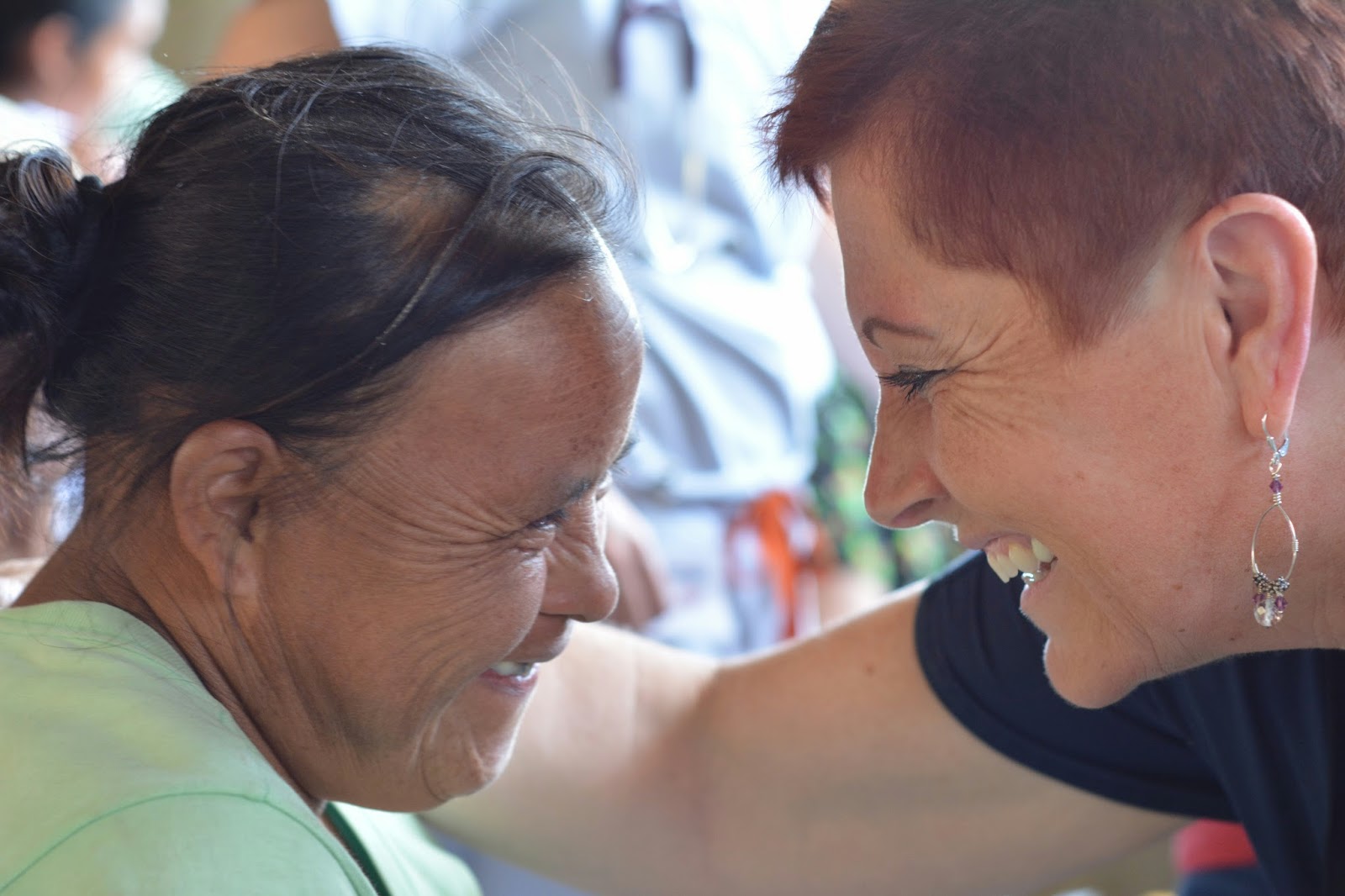
Face wrinkled with the lines of life, the Guatemalan mother cupped her daughter’s face with her hands to whisper one word.
“Hermosa.” Beautiful.
Just seconds before, I had bent down between them to share the photo I had captured of the woman’s daughter. Living with Down Syndrome, the 35-year-old turned toward her mother as the creases along her eyes crinkled with a smile.
It was the first time she had seen her own face.

Karen with HIM hugs a young woman waiting at the dental clinic. Christine Rushton | Murrow College

In a mountain village two hours from Zacapa, the Hearts in Motion dental crew set up a triage clinic to pull teeth for the locals on Tuesday. The team stood in the bed of barred-in pickup trucks to drive an hour up the rocky road.
The Guatemalan woman who asked for the photo had arrived that afternoon for help relieving her aching tooth. She and about 40 other locals gathered at the shed, the largest building available for the doctors to pull teeth. 
Jumping from station to station, I noticed mouths of babies, mouths of adults and mouths of the elderly all filled with rot. Age did not seem to factor into the issue.
Dr. Steve Woodard, an oral surgeon from Spokane, Wash., explained that the Guatemalans put sugar in their water and eat a diet of sugar-laden foods. Soda in the country is less expensive than water, and money drives their decisions.

Dr. Steve Woodard with a patient.           Christine Rushton | Murrow College

His first patient, a girl clutching a brown teddy bear, opened her mouth to reveal four rotted teeth in the front of her top row. Dr. Woodard pulled them all.
For the village the team visited today, corn is the primary source of food; corn contains a high percentage of natural sugar.

The triage dental clinic in the mountains.         Christine Rushton | Murrow College

On the bus trip home, Dr. John Miller shared his experience as an oral surgeon volunteering in the country.
“Those kids today didn’t even know why they were there,” he said.
Dr. Miller narrowed the dental problem to four contributing factors:
1. Low price of soda.
2. Limited access to dentistry.
3. Lack of education on proper hygiene.
4. No money for toothbrushes and toothpaste.
The people do not have the resources to preserve their dental hygiene. Those that have permanent teeth pulled have to rely on mushed or soft food for nutrients the rest of their life. The doctors leave knowing they soothed temporary pain.
But as Dr. Miller commented in reference to the shortcomings of the dentists’ efforts, the economy and education system does not meet the need.


A mountain village in Zacapa.             Christine Rushton | Murrow College